
Technical Guides
Ceramic Fiber Blanket, Board and Module
Ceramic fiber blanket, board and module are three forms of alumina-silicate fiber insulation supplied in the same four grades. Blanket is flexible and the lightest, at 64 to 140 kg/m³. Board is rigid at 260 to 320 kg/m³ and resists wind erosion. Module is a pre-assembled block at 220 kg/m³ that builds a seamless lining. Grade, not form, sets the temperature limit.
- Product family
- Ceramic Fiber Products
- Products compared
- 3
What is ceramic fiber insulation?
Ceramic fiber is an alumina-silicate insulating material supplied by RISING REFRACTORY in three physical forms: blanket, board and module. All three are offered in the same four grades, and the grade is what determines the chemistry and the temperature the product will hold.
The four grades are STD (standard), HP (high purity), HA (high alumina) and HZ (zirconia-containing). Moving up the range raises the alumina content, or adds zirconia, and lowers the iron and alkali content.
- STD — standard alumina-silicate grade
- HP — high purity, with lower iron and alkali levels
- HA — high alumina, raising the alumina content above 52 percent
- HZ — zirconia-containing, carrying 15 to 17 percent ZrO₂ in blanket form
Key differences between the three forms
The forms differ in rigidity, density and how they are put in place. The specification tables state each one's density directly, and that figure is the clearest separator between them.
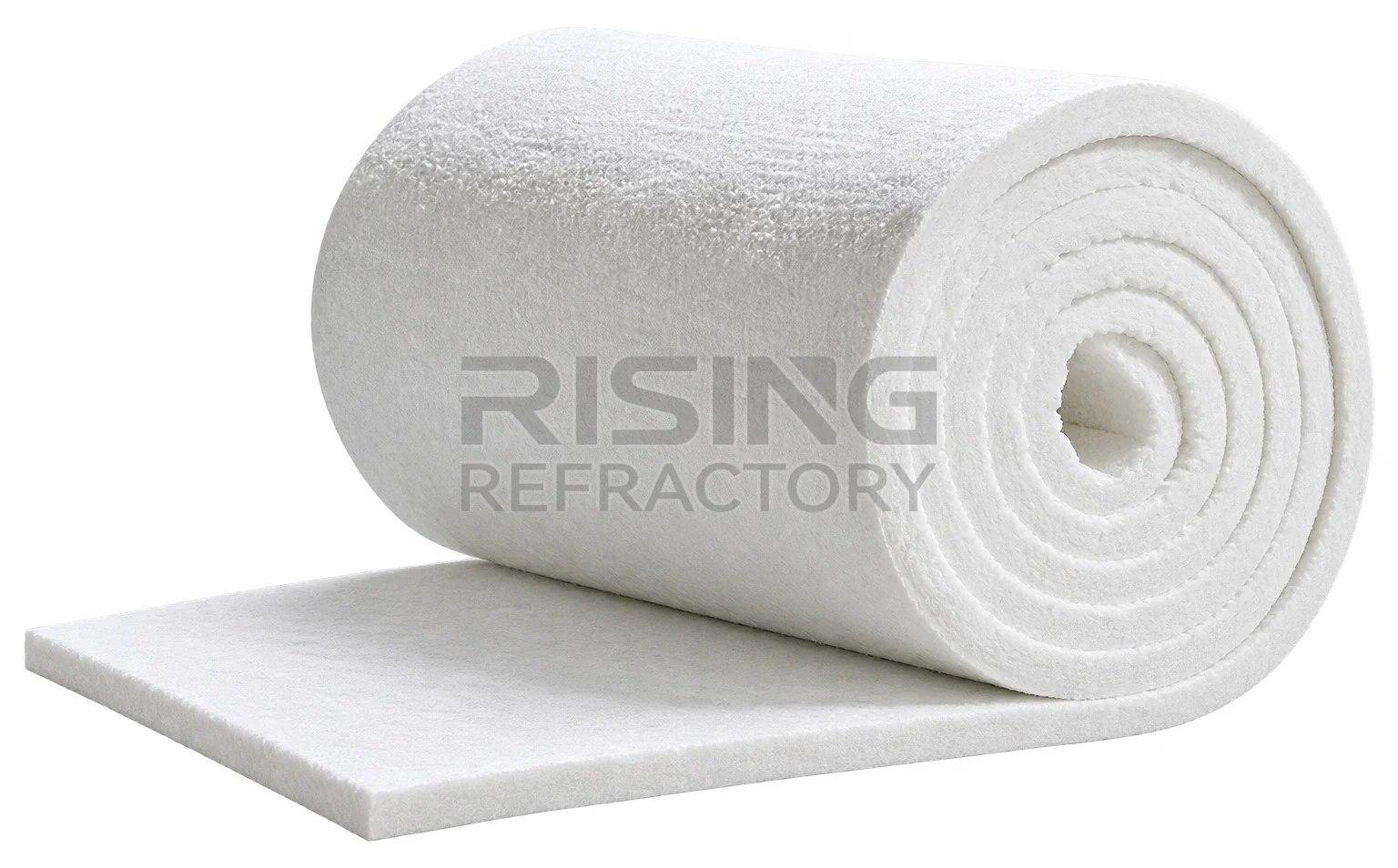
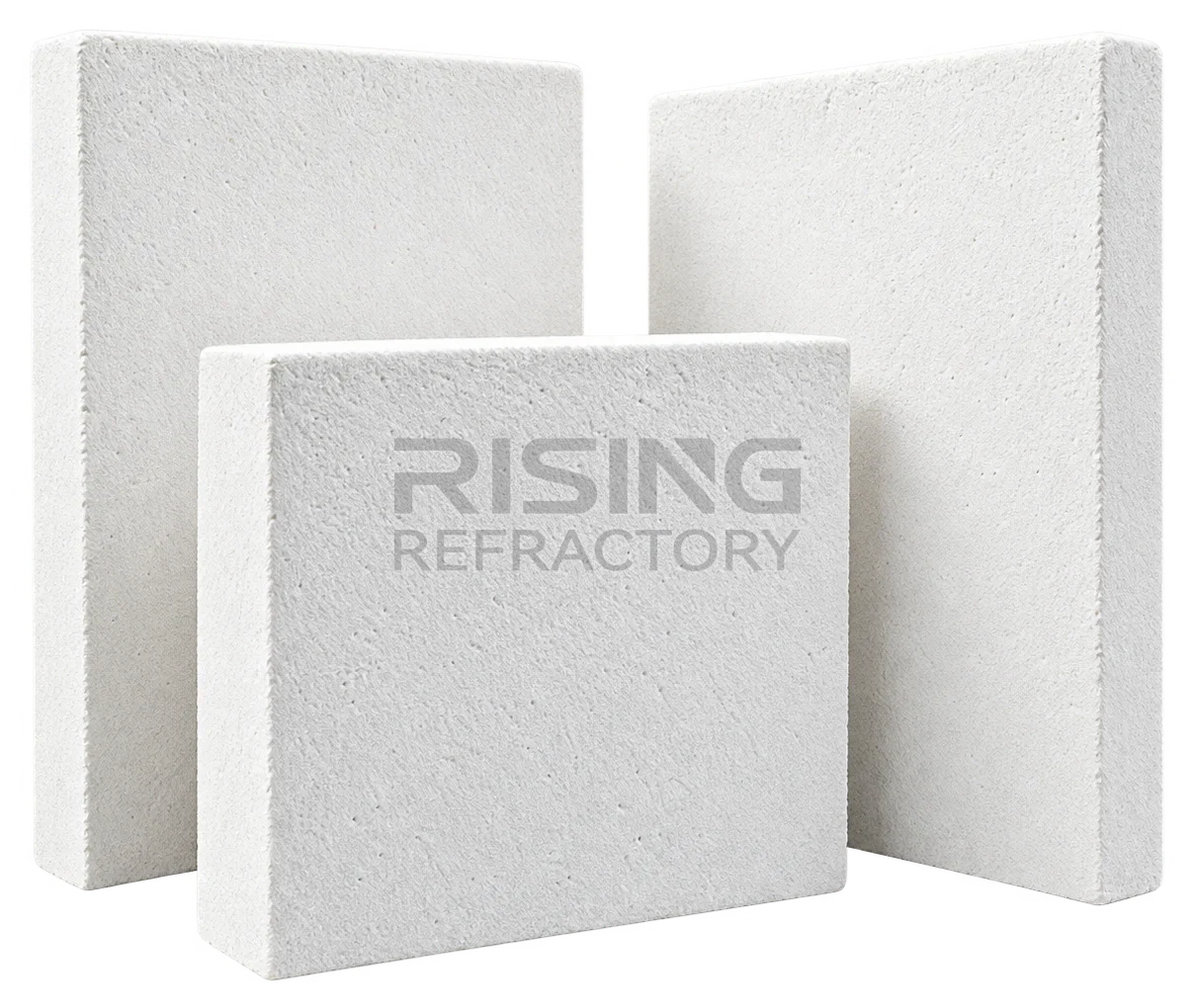
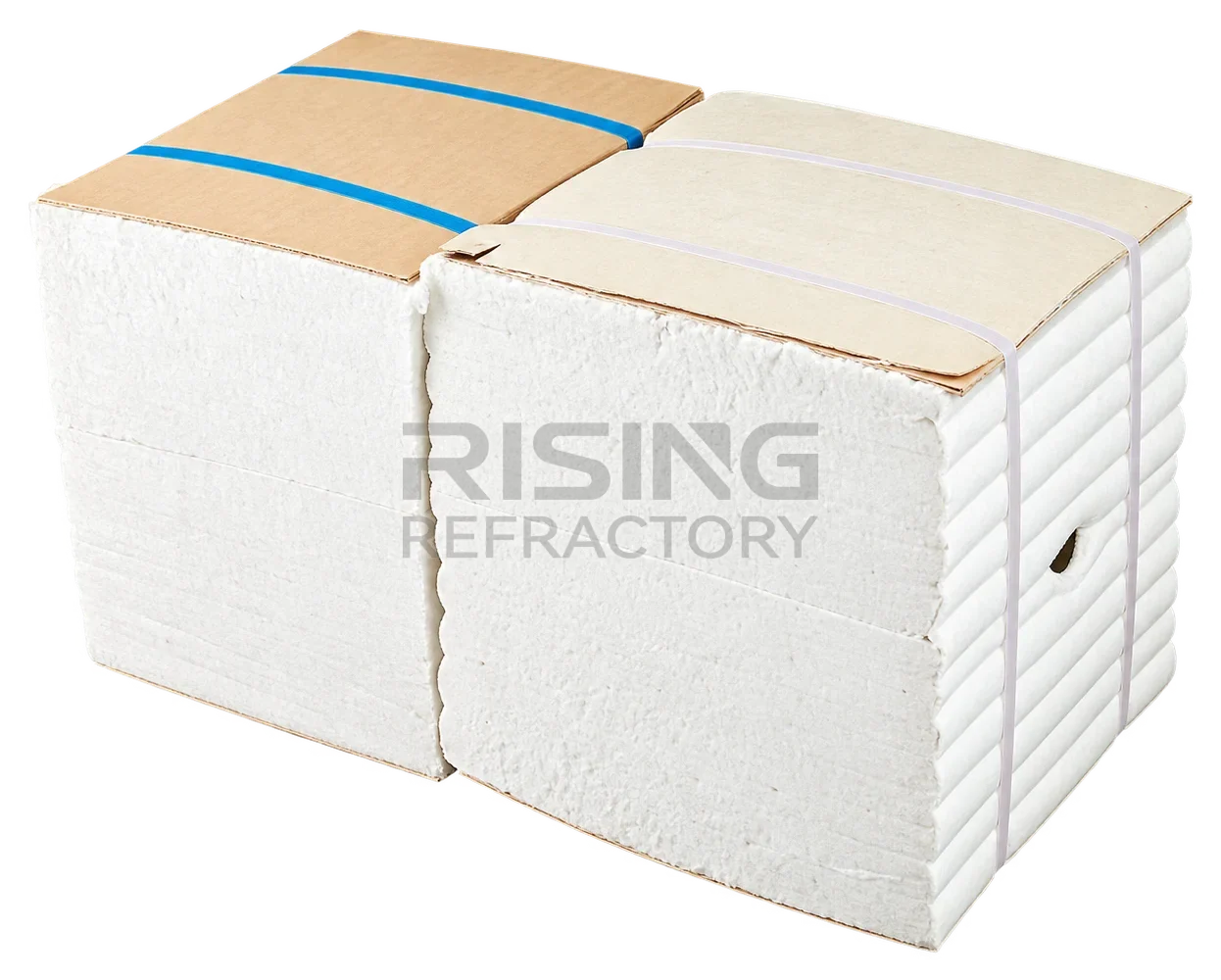
Blanket is flexible and the lightest of the three, at 64 to 140 kg/m³. Board is rigid, at 260 to 320 kg/m³, and the specification describes it as tough, strong and resistant to wind erosion, light and easy to cut. Module is supplied as a pre-assembled block at 220 kg/m³ in 300 × 300 × 200 mm and 300 × 300 × 250 mm sizes, and the specification states that it gives a seamless lining that compensates for fiber shrinkage and installs quickly.
- Blanket — flexible, lowest density, supplied in roll form
- Board — rigid, highest density, cuttable, resists wind erosion
- Module — pre-assembled block, fixed sizes, seamless lining, fast installation
Working temperature by grade and form
The temperature a ceramic fiber product will hold depends on its grade, and the published tables state it per grade rather than per form. Blanket and board give the figure explicitly; the module table states permanent linear change at a test temperature instead.
Blanket is listed with a maximum working temperature of 1200, 1260, 1350 and 1400 °C for STD, HP, HA and HZ. Board is listed with a working temperature of 1000, 1100, 1260 and 1360 °C for the same four grades. The module table gives no working-temperature row; it states permanent linear change of at most 3 percent after 24 hours at 1000, 1100, 1200 and 1350 °C.
Because the module table reports a shrinkage test rather than a working temperature, the two are not interchangeable and no working temperature is claimed here for module.
Thermal conductivity
Both the blanket and board tables report thermal conductivity at a stated reference density, which matters when comparing them: the two figures are not measured at the same density.
Blanket is reported at 128 kg/m³ and board at 285 kg/m³. At 800 °C the blanket figure is 0.14 W/(m·K) for STD and HP; the board figure at the same temperature is 0.132 W/(m·K) across STD, HP and HA. The module table reports no thermal conductivity.
Applications
The verified application context differs by form, and each form is mapped only to the industries its own product entry names.
Ceramic fiber board is the most widely mapped of the three, carrying verified application in steel and iron, glass, chemical and petrochemical, and nonferrous metals. Blanket is mapped to power and CFB boilers and to chemical and petrochemical. Module is mapped to chemical and petrochemical. The board entry also names kilns, pipes and other thermal insulation equipment.
Ceramic fiber blanket additionally appears in the verified project record: it is one of the materials in the steel-industry supply reference for Kuwait.
Selection considerations
Three things separate the forms in practice, and all three are stated in the specification rather than inferred.
Form follows the surface: a flexible blanket wraps and fills, a rigid board holds a shape and takes cutting, and a module builds a lining without joints. Density follows the form and is fixed by it. Temperature follows the grade, so a higher-temperature requirement is answered by moving from STD towards HZ rather than by changing form.
Where a requirement depends on a figure the tables do not carry, such as a working temperature for module or a thermal conductivity at a density other than the one reported, the technical team confirms it against current production before it is quoted.
Comparison tables
Figures are copied from the product pages linked below. An empty cell means the specification states no value for that material; nothing has been carried across from another.
Blanket, board and module compared
| Property | Unit | Blanket | Board | Module |
|---|---|---|---|---|
| Physical form | Flexible | Rigid | Pre-assembled block | |
| Density | kg/m³ | 64~140 | 260/320 | 220 |
| Grades offered | STD, HP, HA, HZ | STD, HP, HA, HZ | STD, HP, HA, HZ | |
| Working temperature, STD grade | ℃ | 1200 | 1000 | |
| Working temperature, HP grade | ℃ | 1260 | 1100 | |
| Working temperature, HA grade | ℃ | 1350 | 1260 | |
| Working temperature, HZ grade | ℃ | 1400 | 1360 | |
| Al₂O₃, STD grade | % | 44~46 | ≥45 | ≥45 |
| Al₂O₃, HA grade | % | 52~55 | ≥52 | ≥53 |
| Thermal conductivity at 800℃ | W/(m·K) | 0.14 (at 128 kg/m³) | 0.132 (at 285 kg/m³) | |
| Mechanical strength | MPa | 0.04 tensile | 0.5 crushing | |
| Supplied size | mm | 300×300×200 / 300×300×250 |
Values as published on the three product pages. An empty cell means the specification states no value for that form, and nothing has been carried across from another form.
- Module states permanent linear change of ≤-3% after 24 hours at 1000, 1100, 1200 and 1350 ℃ for the four grades. That is a shrinkage test, not a working temperature, so the working-temperature cells are left empty.
- The two thermal-conductivity figures are measured at different reference densities and are reproduced with those densities attached.
Related products
Each product page carries the full specification table this guide draws on, together with its own source reference.
Ceramic Fiber Products
Ceramic Fiber Blanket
Ceramic fiber blanket combining fire resistance, heat insulation and heat retention, with low heat capacity and thermal conductivity, in standard, high-purity, high-alumina and zirconia-containing grades.
View ProductGradesSTD · HP · HA · HZ
Ceramic Fiber Products
Ceramic Fiber Board
Rigid ceramic fiber board with excellent toughness, strength and wind-erosion resistance, light and easy to cut, for kilns, pipes and other thermal insulation equipment. Standard, high-purity, high-alumina and zirconia grades.
View ProductGradesSTD · HP · HA · HZ
Ceramic Fiber Products
Ceramic Fiber Module
Ceramic fiber lining module with excellent chemical stability, thermal stability and elasticity, giving a seamless lining that compensates for fiber shrinkage and installs quickly. Four grades in 300 × 300 × 200 / 250 mm sizes.
View ProductGradesSTD · HP · HA · HZ
Need a technical data sheet or specification?
Published technical tables cover every catalogue product. A data sheet for a specific grade, quantity or service condition is issued by the technical team on request.